Wednesday, January 16, 2008
DONALD WILLIAM MACKAY - Fluoridation Fighter .

4TH JULY 1950 - 17TH MAY 2007
Don’s Eulogy (see previous post re the shocking way the medical system in Australia killed my lovely brave husband)
This was read at the funeral by the celebrant.
The Man and Me
Sleeping at night my palm opened flat on his chest,
Warmth feeding warmth, I know we are blessed.
No matter the day’s misunderstandings and blues;
No matter points made and lost;
No matter who thinks who’s the boss;
Sleeping always next to him is the life I would choose.
Re arranging pillows, blankets and such;
Both easy to fire off, yet both easy to touch.
Each unwilling to give way, equal to the end.
The Celt in us both, a marvellous brew,
Stirred and stirring, a wondrous stew.
Sleeping hand to chest our rousing battles mend.
Ah! And give me that fire, pure and unpolished,
And give me the spirit, no argument undemolished,
And give me the wickedness and its play,
Give me the empathy and knowing
Give me the common sense for our growing.
And let us wake hand to chest at the start of the day.
How dear to me is the man who breathes beside me at night?
How dear is the spirit, which gives his eyes their light?
How dear to me is the world we share?
There is no measure I can explain
But that his pain gives me also pain
And that our love is sometimes more than we can bear.
For me he stands, young, fair and clear-eyed as in youth.
For me, the things he feels I know, they are truth.
And I will hold these truths like rare and precious treasure,
For in a shifting sea of easy useless lies
The values of such truths are cherished ties
To the love which lives within the heart which is without measure.
So let me lie for hours, my hand upon his chest,
Thinking on the treasures with which we are blessed.
Such as our children treading out into the world to be,
Carrying the dreams of all our life;
Treasures as sacred as the man and wife
And as sacred as the love which binds the man to me.
With Love Therese
Read by
Ian Mackay Don's brother
The dash between 1950 and 2007 is the period Don was with us. It is the most important dash that we know. It fulfils his life and the love that we know both from Don and to him.
My portion of Dons life is mainly from birth till his early twenties.
BORN on 4th July 1950 the fourth child of Rod & Kath Mackay in the western town of Moree. His family consisted of firstly
Jeanette… (Tet)
Judith… (Jude) and myself
Ian. …Not counting the main proponents of the family Dad (Rod) & Mum (Kath).
My sisters used to dote on me until this kid called “Don” arrived, it changed after that and he became the dotee. That didn’t matter all that much as they couldn’t play marbles and didn’t go much on catching frogs.
Not much to do in Moree,
One evening at dinner not long after his first birthday Don said to us and all,
“We should go to the Snowy and build the Eucumbene Dam as they need people like us” He was a very advanced child. As a group of half a dozen we set off to build a dam. Turns out it was a bit bigger than the six of us could handle, so we called in a few more people (1000 actually) it took about six years to complete. Those six years probably formed Don into the person he became in later years.
The things that we got up to, as kids would have sent you to a home of some sort or other. It included, the four of us setting out for a bike ride of a lifetime, ending up in a pigsty at the original dam site, with a raging fire that could have burnt an average National park. Someone volunteered me to get Mum and Dad (Tet I’m sure) in a raging stormy freezing cold on a 10 mile ride in the dark, with the cavalry Mum & Dad the three eldest – me included were chastised severely. “What were you thinking taking this young baby out in this weather”. As quick as, Tet said “Mum at least he is warm and dry and he is not a baby he is four years old. It ended well. The kids could do no wrong.
The Shooting,
Don & I were shooting tadpoles and frogs in a creek near home. I had just shot a frog and Don said give me a shot: I gave him the slug gun and he said to me “see how you like it” and promptly shot me in the foot.
That was the start of his GREENY ATTITUDE. Not content with the foot shooting when we got home he reloaded the slug gun and chased me around the house.
Fishing
A mate and myself were going fishing and knocked off a bunch of carrots from the headmasters place to eat while fishing next thing Don and his mate Ian ‘Ackenzie’ his real name was Mackenzie but Don couldn’t get his tongue around that, caught us and dobbed us into the headmaster- Mr Faulkner. Don got extra points for that. The mate and I panicked when called to his office, but being a great teacher he didn’t go crook instead gave us a lesson on tying fishhooks.
The remainder of our stay in the Adaminaby Dam site was filled with family love and love of family a really great place to grow up as a child.
Dam completed Don called us together again and said that the people were having troubles with a dam at Tan Tanungra and felt that we should help a fairly uneventful part of our lives Don schooled at New Adaminaby. Tet worked with Dad and Jude helped mum at the local shop.
Don again gathered us after our Sunday roast and weekly caster oil and said, “there are problems with a power site at the Lake Macquarie we should go and help”
Swansea this joint had it all
TV - never seen that
Beaches - been on holiday
Lakes - made them
Fishing - caught millions and masses of adventures that four kids from the Snowy had never seen.
Don became a super star at Soccer in the under 14s and we both completed schooling there. From there the family fragmented.
Tet married Jack Holmes and had a son Phillip all died in a car accident 1969.
Jude married Buddy whom died in a car accident in 1965.
I married Monika and had a son Terry and daughter Jenny.
Jude remarried, Kevin and had a son Rodney and daughter Joanne.
Don said they were calling from Port Headland in WA. The family fragmented further, as mum and dad with Don in tow headed there to sort out the problems the Port mob encountered.
The problem solved and plans to return to Swansea were completed. However Dad encountered cancer and lost the battle in the Sir Charles Gardiner Hospital in Perth on 31 Jan 1966.
Don and mum returned to the eastern states, I got leave from Vietnam to see Dad before he passed but unfortunately due to slow transport missed seeing him before passing. My leave was far to short and I returned to Vietnam whilst Mum and Don went to Maroon country in Brisbane where the tied up with Jude.
With Brisbane a temporary base Don now 17 headed to Blackwater mines 4-500 kilometres west of Rocky. This part of his life was born “The wild child” bought new cars and demolished them at a rapid rate.
Mum returned to Cardiff and Don soon followed and sort of lost the Wild Child a bit when he met
Therese and had two daughters
Melissa in 1974
Alison in 1977.
The remainder of his story is related by Therese through Garry our celebrant.
To have known Don as a brother was a privilege and to have loved and be loved by him irreplaceable.
DON REST IN PEACE, WE ALL LOVE YOU.
Therese’s part
Don, from 1972
Don and Therese met in Newcastle in 1972 and joined forces about three weeks after that meeting. Don was then working as a Fitter for Hodge Industrial installing underground petrol tanks and bowsers all across NSW.
In 1974 Melissa was born to them and Don’s boss offered them the use of a large caravan to use so that Don would not want to come home each weekend to be with his family and could spend months moving around NSW working.
This was a wonderful 18 months and there were few areas they did not get to spend time. Blayney in winter in an uninsulated caravan was an experience. Opening the van door at the tick gates and seeing their red kelpie, called Red, slithering around in the beetroot which had fallen out of the fridge, because someone had forgotten to put the pin in the fridge door was another.
Port Macquarie was one of the towns they visited and Don was offered work from Gordon Hunt should he ever move here.
In late ’76 they moved to Port Macquarie.
Alison was born in 1977 and the family was complete.
They lived in a small house just past Sea Acres near Johnson’s Fruit shop, which cost $12 a week. Here they were home. Chooks, ducks, a dog – Boris, cats – (Don was never too keen on these creatures) and Lucky - Don’s horse, two happy little girls and little money made this a happy home for Don and Therese
He worked on building sites and drove a backhoe and truck and was able to turn his hand to most things he tried.
In 1982 Don was badly injured while working in the canals behind Settlement City.
He became a quadriplegic and spent a seven-month stay at Royal North Shore Hospital (Sydney). Therese, Melissa and Alison moved for that period living near the hospital, with Therese’s eldest sister Veronica. All returned to Port Macquarie when Don was well enough
After a settling period, Don along with his wife Therese became involved in issues in which he believed in passionately. He lobbied Council in the ‘80’s for better wheelchair access and struck a deal with them that he would go halves in the cost of construction of wheelchair access on major access points around the CBD.
In the early ‘90’s he manned the RSPCA phone and was passionate about his commitment to this. Although it’s a well known fact Don was not a great cat lover, he abhorred cruelty of any sort and would too often be upset by the callousness of human beings to their pets and livestock.
His mother died in 1997. He not only looked out for his mother’s needs but also Therese’s mother and was always quick to see when others were had difficulties. He had a great compassion for others who were suffering illness or other.
When his sister Judy was dying in Queensland in 1998 he and Therese spent the last three months with her only leaving a few days before she passed away. This was a special time and he spent many days just quietly sitting by his sister’s bedside talking and laughing about family.
He believed ardently in the right of the individual to freedom of choice on issues regarding Fluoridation, and other and it is well known he did not suffer fools gladly. He was very active in the fight against the privatisation of Port Macquarie Hospital and he worked for years tirelessly to have the hospital returned to public hands.
Unfortunately he was stuck in bed on the day the Hospital Action Group had its celebration outside the hospital grounds once again when the hospital was finally handed back to the people of NSW in 2004, but he spent that morning harassing the local media, as was his wont, into speaking with the Hospital Action Group who were there from the beginning of the fight in early 1992.
He became actively involved in One Nation, and along with Marge Rowsell from Taree organised the original meeting in the Civic Centre when Pauline came to Port Macquarie and filled the Civic Centre to overflowing on a Tuesday morning. When Pauline moved away from One Nation so did Don. He was outraged by her jailing and worked as hard as he could writing letters etc to help raise awareness of the injustice often saying that if it could happen to such a public figure as Pauline, it could happen to any one of us, and that we each, on our own, must always fight against injustice when we are able…
When Pauline was released, fully exonerated he was over the moon.
Don and Therese moved out here to Craggy Island in early 2004. The sense of peace and beauty they both felt the first day they saw this place is still here with us and for Therese it is the essence of her husband and a fitting place for this service.
Becoming a Quadriplegic was bad enough, but Don was unlucky in that he was suffered constant pain and would comment on those few days when it totally lifted how good the day was. As the years went on this became much worse. His courage and endurance, still being able to be concerned about others, smiling, fooling about, being involved and interested and most of all never complaining, was truly wonderful to experience. It was heartbreaking at times when people did not understand his fragility and his exhaustion and bravery he showed by just facing the days at times.
The family are aware of the many roles Don played in life and on the small screen, where just the placement of a wig, or a hat and he would transform into little fat Eadie from Picnic at Hanging Rock which should now be known as “Picnic at Don Rock”…and his Mafia alter ego called “The Don” was done as seamlessly as he did everything.
There was the eighth day of the week “Don Day” which was a special day for the kids.
His force of personality and its many facets became something of a miracle to his family and especially Therese, Melissa and Alison. He was constantly concerned about their welfare, and that of the extended family, and he seemed to grow more compassionate, the more he suffered.
Melissa and Alison joke about the fact that they quickly learnt to never say they were bored because when they did he would give them jobs to do. Now adults they say they are grateful for this. He was fiercely independent and a gentle and concerned loving husband and father.
He passed away at his home on Thursday 17th May, two days before his eldest daughter Melissa and her fiancé Chris were due to be married. He had been in RNSH for 5 weeks and was flown home the night of his passing. Unable to speak because of the Ventilator for the past 5 weeks, when it was finally turned off, he softly talked and joked with those of us gathered for about two hours. He died with his family around him and was loved gently as he went with dignity and concern for others welfare the last things he expressed.
The manner of his passing after the terrible suffering he endured, will never be forgotten by those of us present, and has left us with no fear of death… none at all. Yet another of the precious gifts he left to those he loved. He was beautiful to the end and died quietly with his daughters and wife and other loved ones… in a quiet room... at home at last. He deserved such a peaceful seamless death to this life. His compassion and empathy for others; his sense of fun and stirring; his generosity; his unpredictability; his intense love of the natural world; so much, but more even was the love he held for his children Melissa and Alison, and his wife Therese. He loved them without conditions. Its known Don had his rough edges but the rough diamonds are always the best, and are always more precious
Thanks must go out to Therese’s sisters Veronica, Joan and Jackie for their support. Jackie spent the last day in the hospital with Don while the family drove home to meet the Air Ambulance. She went on the flight with him so that he always had someone with him he loved. Thanks to Carmel, Patsy, Mike, Rod, Neil and Renata, and Donna, and they know why.
The effort made by Don’s Doctor Dr Mark Stewart and the Air Ambulance and others made it possible for Don to have his last wish, which was to die at home.
He is survived by Therese his wife, Melissa and Alison his daughters and Ian his brother.
Goodbye for now our lovely Eadie… See you round like a rissole.
Melissa’s part
One things for sure this world will never be the same again without Don or better known as Noddy to Ali Mum and I.
Whenever I think of him it always makes me smile and a million memories come rushing to me. Each one making me happier. Dad had a wonderful sense of fun and a wicked wicked sense of humour. Which left a lot of people not quite sure, was he laughing at them? That made it funnier. Alison and I from a young age absolutely loved when he was being wickedly funny. Kids love it when someone can get away with saying and doing things naughty. Ali do you remember your first communion? I know mum and I sure do! Only 20 cents for a glass of water. We had some amazing times as a family, you couldn’t ask or wish for a better dad. He was always always there for you, and nothing was ever too much. The gap in our little family is going to be felt, but he is always with us, because he promised me once. I remember when dad was in hospital, his arms were tied with restraints, mum and I untied them and he stretched out his arms like he was going to fly away. I said jokingly, YOUR FREE! And he laughed and smiled it was the most beautiful smile. So I hope he is free and still has that beautiful smile, that I’ll never forget.
He deserves all the wonders of complete freedom and happiness.
Melissa Mackay
21.5.2007
Alison’s part
Where do I start, when trying to say goodbye, or a final “see you later” to you Dad? I know that you will always be with me & that I will meet you again, but for now you need to rest. I am so sorry for what happened to you at Royal North Shore Hospital, it was as you said “Shithouse”. We were lucky to have been with you at the end. I hope that you could feel all the love from us.
You & Mum gave us such a fun & rich childhood; there was always much laughter in the house. There are so many stories and great times that will always be with my heart. Thankyou for teaching me so many things its strange but I still remember each moment so clear when you taught me to tie my shoelaces, to dive properly into the pool, my times tables, telling the time on a real clock. All the times you watched me swimming by myself in the pool because I was always to scared jaws would get me if you weren’t watching. You would try to sneak away after a long while but I’d always catch you and you’d always come back out.
There were always lots of cuddles in our house, interesting games of monopoly, jobs if we admitted boredom, and there was always a right way to do jobs and a short time in which to begin them. That was just you though Dad and it became slightly amusing as we got older.
We have so many funny home videos of us four and others, but by far the best was our “Picnic at Don Rock!” you played Edie brilliantly and we have so many one-liners from it that will always make us laugh.
Thank you Dad for always being so helpful and kind to me. You always tried to make things better for me. All the phone calls over the last few years I will cherish. All the stories you told, all the silly voices we did. You taught me how to cope with things that were beyond my grasp, and always when the seriousness was over you’d get me chuckling again.
People tell me that I am like you in many ways and I am proud of that. You always taught me to stand up for myself too, which I am grateful for. You did so with such phrases as “Don’t take shit” and “are you gunna put up with that?” Dad you always taught me to be strong and fair. Two qualities that you have.
I will always love and cherish you, there have just been so many funny and warm times shared. I am so lucky to of have had a father like you, a friend like you and a teacher like you.
Take care Dad wherever you are right now, and always know how proud I am of you for who you are, how you lived, how you dealt with hardship’s, how you joked and how you loved.
I love you
Love always Ali

4TH JULY 1950 - 17TH MAY 2007
Don’s Eulogy (see previous post re the shocking way the medical system in Australia killed my lovely brave husband)
This was read at the funeral by the celebrant.
The Man and Me
Sleeping at night my palm opened flat on his chest,
Warmth feeding warmth, I know we are blessed.
No matter the day’s misunderstandings and blues;
No matter points made and lost;
No matter who thinks who’s the boss;
Sleeping always next to him is the life I would choose.
Re arranging pillows, blankets and such;
Both easy to fire off, yet both easy to touch.
Each unwilling to give way, equal to the end.
The Celt in us both, a marvellous brew,
Stirred and stirring, a wondrous stew.
Sleeping hand to chest our rousing battles mend.
Ah! And give me that fire, pure and unpolished,
And give me the spirit, no argument undemolished,
And give me the wickedness and its play,
Give me the empathy and knowing
Give me the common sense for our growing.
And let us wake hand to chest at the start of the day.
How dear to me is the man who breathes beside me at night?
How dear is the spirit, which gives his eyes their light?
How dear to me is the world we share?
There is no measure I can explain
But that his pain gives me also pain
And that our love is sometimes more than we can bear.
For me he stands, young, fair and clear-eyed as in youth.
For me, the things he feels I know, they are truth.
And I will hold these truths like rare and precious treasure,
For in a shifting sea of easy useless lies
The values of such truths are cherished ties
To the love which lives within the heart which is without measure.
So let me lie for hours, my hand upon his chest,
Thinking on the treasures with which we are blessed.
Such as our children treading out into the world to be,
Carrying the dreams of all our life;
Treasures as sacred as the man and wife
And as sacred as the love which binds the man to me.
With Love Therese
Read by
Ian Mackay Don's brother
The dash between 1950 and 2007 is the period Don was with us. It is the most important dash that we know. It fulfils his life and the love that we know both from Don and to him.
My portion of Dons life is mainly from birth till his early twenties.
BORN on 4th July 1950 the fourth child of Rod & Kath Mackay in the western town of Moree. His family consisted of firstly
Jeanette… (Tet)
Judith… (Jude) and myself
Ian. …Not counting the main proponents of the family Dad (Rod) & Mum (Kath).
My sisters used to dote on me until this kid called “Don” arrived, it changed after that and he became the dotee. That didn’t matter all that much as they couldn’t play marbles and didn’t go much on catching frogs.
Not much to do in Moree,
One evening at dinner not long after his first birthday Don said to us and all,
“We should go to the Snowy and build the Eucumbene Dam as they need people like us” He was a very advanced child. As a group of half a dozen we set off to build a dam. Turns out it was a bit bigger than the six of us could handle, so we called in a few more people (1000 actually) it took about six years to complete. Those six years probably formed Don into the person he became in later years.
The things that we got up to, as kids would have sent you to a home of some sort or other. It included, the four of us setting out for a bike ride of a lifetime, ending up in a pigsty at the original dam site, with a raging fire that could have burnt an average National park. Someone volunteered me to get Mum and Dad (Tet I’m sure) in a raging stormy freezing cold on a 10 mile ride in the dark, with the cavalry Mum & Dad the three eldest – me included were chastised severely. “What were you thinking taking this young baby out in this weather”. As quick as, Tet said “Mum at least he is warm and dry and he is not a baby he is four years old. It ended well. The kids could do no wrong.
The Shooting,
Don & I were shooting tadpoles and frogs in a creek near home. I had just shot a frog and Don said give me a shot: I gave him the slug gun and he said to me “see how you like it” and promptly shot me in the foot.
That was the start of his GREENY ATTITUDE. Not content with the foot shooting when we got home he reloaded the slug gun and chased me around the house.
Fishing
A mate and myself were going fishing and knocked off a bunch of carrots from the headmasters place to eat while fishing next thing Don and his mate Ian ‘Ackenzie’ his real name was Mackenzie but Don couldn’t get his tongue around that, caught us and dobbed us into the headmaster- Mr Faulkner. Don got extra points for that. The mate and I panicked when called to his office, but being a great teacher he didn’t go crook instead gave us a lesson on tying fishhooks.
The remainder of our stay in the Adaminaby Dam site was filled with family love and love of family a really great place to grow up as a child.
Dam completed Don called us together again and said that the people were having troubles with a dam at Tan Tanungra and felt that we should help a fairly uneventful part of our lives Don schooled at New Adaminaby. Tet worked with Dad and Jude helped mum at the local shop.
Don again gathered us after our Sunday roast and weekly caster oil and said, “there are problems with a power site at the Lake Macquarie we should go and help”
Swansea this joint had it all
TV - never seen that
Beaches - been on holiday
Lakes - made them
Fishing - caught millions and masses of adventures that four kids from the Snowy had never seen.
Don became a super star at Soccer in the under 14s and we both completed schooling there. From there the family fragmented.
Tet married Jack Holmes and had a son Phillip all died in a car accident 1969.
Jude married Buddy whom died in a car accident in 1965.
I married Monika and had a son Terry and daughter Jenny.
Jude remarried, Kevin and had a son Rodney and daughter Joanne.
Don said they were calling from Port Headland in WA. The family fragmented further, as mum and dad with Don in tow headed there to sort out the problems the Port mob encountered.
The problem solved and plans to return to Swansea were completed. However Dad encountered cancer and lost the battle in the Sir Charles Gardiner Hospital in Perth on 31 Jan 1966.
Don and mum returned to the eastern states, I got leave from Vietnam to see Dad before he passed but unfortunately due to slow transport missed seeing him before passing. My leave was far to short and I returned to Vietnam whilst Mum and Don went to Maroon country in Brisbane where the tied up with Jude.
With Brisbane a temporary base Don now 17 headed to Blackwater mines 4-500 kilometres west of Rocky. This part of his life was born “The wild child” bought new cars and demolished them at a rapid rate.
Mum returned to Cardiff and Don soon followed and sort of lost the Wild Child a bit when he met
Therese and had two daughters
Melissa in 1974
Alison in 1977.
The remainder of his story is related by Therese through Garry our celebrant.
To have known Don as a brother was a privilege and to have loved and be loved by him irreplaceable.
DON REST IN PEACE, WE ALL LOVE YOU.
Therese’s part
Don, from 1972
Don and Therese met in Newcastle in 1972 and joined forces about three weeks after that meeting. Don was then working as a Fitter for Hodge Industrial installing underground petrol tanks and bowsers all across NSW.
In 1974 Melissa was born to them and Don’s boss offered them the use of a large caravan to use so that Don would not want to come home each weekend to be with his family and could spend months moving around NSW working.
This was a wonderful 18 months and there were few areas they did not get to spend time. Blayney in winter in an uninsulated caravan was an experience. Opening the van door at the tick gates and seeing their red kelpie, called Red, slithering around in the beetroot which had fallen out of the fridge, because someone had forgotten to put the pin in the fridge door was another.
Port Macquarie was one of the towns they visited and Don was offered work from Gordon Hunt should he ever move here.
In late ’76 they moved to Port Macquarie.
Alison was born in 1977 and the family was complete.
They lived in a small house just past Sea Acres near Johnson’s Fruit shop, which cost $12 a week. Here they were home. Chooks, ducks, a dog – Boris, cats – (Don was never too keen on these creatures) and Lucky - Don’s horse, two happy little girls and little money made this a happy home for Don and Therese
He worked on building sites and drove a backhoe and truck and was able to turn his hand to most things he tried.
In 1982 Don was badly injured while working in the canals behind Settlement City.
He became a quadriplegic and spent a seven-month stay at Royal North Shore Hospital (Sydney). Therese, Melissa and Alison moved for that period living near the hospital, with Therese’s eldest sister Veronica. All returned to Port Macquarie when Don was well enough
After a settling period, Don along with his wife Therese became involved in issues in which he believed in passionately. He lobbied Council in the ‘80’s for better wheelchair access and struck a deal with them that he would go halves in the cost of construction of wheelchair access on major access points around the CBD.
In the early ‘90’s he manned the RSPCA phone and was passionate about his commitment to this. Although it’s a well known fact Don was not a great cat lover, he abhorred cruelty of any sort and would too often be upset by the callousness of human beings to their pets and livestock.
His mother died in 1997. He not only looked out for his mother’s needs but also Therese’s mother and was always quick to see when others were had difficulties. He had a great compassion for others who were suffering illness or other.
When his sister Judy was dying in Queensland in 1998 he and Therese spent the last three months with her only leaving a few days before she passed away. This was a special time and he spent many days just quietly sitting by his sister’s bedside talking and laughing about family.
He believed ardently in the right of the individual to freedom of choice on issues regarding Fluoridation, and other and it is well known he did not suffer fools gladly. He was very active in the fight against the privatisation of Port Macquarie Hospital and he worked for years tirelessly to have the hospital returned to public hands.
Unfortunately he was stuck in bed on the day the Hospital Action Group had its celebration outside the hospital grounds once again when the hospital was finally handed back to the people of NSW in 2004, but he spent that morning harassing the local media, as was his wont, into speaking with the Hospital Action Group who were there from the beginning of the fight in early 1992.
He became actively involved in One Nation, and along with Marge Rowsell from Taree organised the original meeting in the Civic Centre when Pauline came to Port Macquarie and filled the Civic Centre to overflowing on a Tuesday morning. When Pauline moved away from One Nation so did Don. He was outraged by her jailing and worked as hard as he could writing letters etc to help raise awareness of the injustice often saying that if it could happen to such a public figure as Pauline, it could happen to any one of us, and that we each, on our own, must always fight against injustice when we are able…
When Pauline was released, fully exonerated he was over the moon.
Don and Therese moved out here to Craggy Island in early 2004. The sense of peace and beauty they both felt the first day they saw this place is still here with us and for Therese it is the essence of her husband and a fitting place for this service.
Becoming a Quadriplegic was bad enough, but Don was unlucky in that he was suffered constant pain and would comment on those few days when it totally lifted how good the day was. As the years went on this became much worse. His courage and endurance, still being able to be concerned about others, smiling, fooling about, being involved and interested and most of all never complaining, was truly wonderful to experience. It was heartbreaking at times when people did not understand his fragility and his exhaustion and bravery he showed by just facing the days at times.
The family are aware of the many roles Don played in life and on the small screen, where just the placement of a wig, or a hat and he would transform into little fat Eadie from Picnic at Hanging Rock which should now be known as “Picnic at Don Rock”…and his Mafia alter ego called “The Don” was done as seamlessly as he did everything.
There was the eighth day of the week “Don Day” which was a special day for the kids.
His force of personality and its many facets became something of a miracle to his family and especially Therese, Melissa and Alison. He was constantly concerned about their welfare, and that of the extended family, and he seemed to grow more compassionate, the more he suffered.
Melissa and Alison joke about the fact that they quickly learnt to never say they were bored because when they did he would give them jobs to do. Now adults they say they are grateful for this. He was fiercely independent and a gentle and concerned loving husband and father.
He passed away at his home on Thursday 17th May, two days before his eldest daughter Melissa and her fiancé Chris were due to be married. He had been in RNSH for 5 weeks and was flown home the night of his passing. Unable to speak because of the Ventilator for the past 5 weeks, when it was finally turned off, he softly talked and joked with those of us gathered for about two hours. He died with his family around him and was loved gently as he went with dignity and concern for others welfare the last things he expressed.
The manner of his passing after the terrible suffering he endured, will never be forgotten by those of us present, and has left us with no fear of death… none at all. Yet another of the precious gifts he left to those he loved. He was beautiful to the end and died quietly with his daughters and wife and other loved ones… in a quiet room... at home at last. He deserved such a peaceful seamless death to this life. His compassion and empathy for others; his sense of fun and stirring; his generosity; his unpredictability; his intense love of the natural world; so much, but more even was the love he held for his children Melissa and Alison, and his wife Therese. He loved them without conditions. Its known Don had his rough edges but the rough diamonds are always the best, and are always more precious
Thanks must go out to Therese’s sisters Veronica, Joan and Jackie for their support. Jackie spent the last day in the hospital with Don while the family drove home to meet the Air Ambulance. She went on the flight with him so that he always had someone with him he loved. Thanks to Carmel, Patsy, Mike, Rod, Neil and Renata, and Donna, and they know why.
The effort made by Don’s Doctor Dr Mark Stewart and the Air Ambulance and others made it possible for Don to have his last wish, which was to die at home.
He is survived by Therese his wife, Melissa and Alison his daughters and Ian his brother.
Goodbye for now our lovely Eadie… See you round like a rissole.
Melissa’s part
One things for sure this world will never be the same again without Don or better known as Noddy to Ali Mum and I.
Whenever I think of him it always makes me smile and a million memories come rushing to me. Each one making me happier. Dad had a wonderful sense of fun and a wicked wicked sense of humour. Which left a lot of people not quite sure, was he laughing at them? That made it funnier. Alison and I from a young age absolutely loved when he was being wickedly funny. Kids love it when someone can get away with saying and doing things naughty. Ali do you remember your first communion? I know mum and I sure do! Only 20 cents for a glass of water. We had some amazing times as a family, you couldn’t ask or wish for a better dad. He was always always there for you, and nothing was ever too much. The gap in our little family is going to be felt, but he is always with us, because he promised me once. I remember when dad was in hospital, his arms were tied with restraints, mum and I untied them and he stretched out his arms like he was going to fly away. I said jokingly, YOUR FREE! And he laughed and smiled it was the most beautiful smile. So I hope he is free and still has that beautiful smile, that I’ll never forget.
He deserves all the wonders of complete freedom and happiness.
Melissa Mackay
21.5.2007
Alison’s part
Where do I start, when trying to say goodbye, or a final “see you later” to you Dad? I know that you will always be with me & that I will meet you again, but for now you need to rest. I am so sorry for what happened to you at Royal North Shore Hospital, it was as you said “Shithouse”. We were lucky to have been with you at the end. I hope that you could feel all the love from us.
You & Mum gave us such a fun & rich childhood; there was always much laughter in the house. There are so many stories and great times that will always be with my heart. Thankyou for teaching me so many things its strange but I still remember each moment so clear when you taught me to tie my shoelaces, to dive properly into the pool, my times tables, telling the time on a real clock. All the times you watched me swimming by myself in the pool because I was always to scared jaws would get me if you weren’t watching. You would try to sneak away after a long while but I’d always catch you and you’d always come back out.
There were always lots of cuddles in our house, interesting games of monopoly, jobs if we admitted boredom, and there was always a right way to do jobs and a short time in which to begin them. That was just you though Dad and it became slightly amusing as we got older.
We have so many funny home videos of us four and others, but by far the best was our “Picnic at Don Rock!” you played Edie brilliantly and we have so many one-liners from it that will always make us laugh.
Thank you Dad for always being so helpful and kind to me. You always tried to make things better for me. All the phone calls over the last few years I will cherish. All the stories you told, all the silly voices we did. You taught me how to cope with things that were beyond my grasp, and always when the seriousness was over you’d get me chuckling again.
People tell me that I am like you in many ways and I am proud of that. You always taught me to stand up for myself too, which I am grateful for. You did so with such phrases as “Don’t take shit” and “are you gunna put up with that?” Dad you always taught me to be strong and fair. Two qualities that you have.
I will always love and cherish you, there have just been so many funny and warm times shared. I am so lucky to of have had a father like you, a friend like you and a teacher like you.
Take care Dad wherever you are right now, and always know how proud I am of you for who you are, how you lived, how you dealt with hardship’s, how you joked and how you loved.
I love you
Love always Ali

Friday, March 16, 2007
Arsenic in my Fluoride? CDC admits Yes
Published on Monday, March 12, 2007
by Healthy News Service
New York – March 12, 2007 -- Trace amounts of arsenic are found in fluoride chemicals added to drinking water supplies, reports the U.S. Centers for Disease Control’s (CDC) website. (1)
Fluoridation is a controversial attempt to reduce tooth decay in tap-water consumers.
Fluoridation chemicals - sodium fluoride, sodium fluorosilicate, and fluorosilicic acid (FSA) – are all derived from the manufacture of phosphate fertilizer, reports the CDC. Trace amounts of unwanted contaminants, such as antimony, barium, beryllium, arsenic and others, are allowed to rema
in in fluoridation chemicals before flowing through America’s faucets (2) The CDC reports, tests by National Sanitation Foundation (NSF) revealed arsenic was present in sample batches of FSA. When trace amounts were present, the treated water had an average of 0.43 parts per billion (ppb) of arsenic, with a high of 1.66 ppb attributable to the fluoride additive. (2)
The NSF sets the allowable level of arsenic in fluoridation chemicals at 2.5 ppb. The maximum contaminant level (MCL) of arsenic in treated water is 10 ppb, set by the Environmental Protection Agency. But the maximum contaminant level goal (MCLG) of arsenic in drinking water is zero (5) and is based on health risks; however, the actual level permitted (MCL) is above 0, to account for difficulty in removing it or in measuring it. (6)
"No water company should purposely be adding arsenic to water supplies –even when it’s attached to a chemical perceived to be beneficial," says Beeber.
Trace levels of arsenic in drinking water increase a person's risk of developing cancer, according to a report from the prestigious US National Academy of Sciences. "People drinking water containing just one part per billion of arsenic have an increased risk of developing bladder or lung cancer of one in 1,000," reports New Scientist magazine. (3)
In an analysis of 25 states, the National Resources Defense Council found about 8,000 U.S. water systems, serving 57,000,000 people, contained arsenic levels at 1 ppb or higher.(4)
"Fluoridation has proven useless in fighting tooth decay in America’s low-income population as the recent unfortunate ‘tooth-decay’ death of a 12-year-old Maryland boy living in a fluoridated area has proven," says lawyer Paul Beeber, President, New York State Coalition Opposed to Fluoridation. "No child is or ever was fluoride-deficient. But many are dentist-deficient," says Beeber.
"Besides, modern science establishes that fluoridation is ineffective at reducing tooth decay, harmful to health and a waste of taxpayer money," says Beeber.
"We're glad the CDC finally admits that arsenic can be found in fluoridation chemicals. But CDC should go further and list all undesirable chemicals and impurities allowed in the fluoridation chemicals, and make it publicly known so consumers truly can make an informed choice," says Beeber.
Contact: Paul S. Beeber, Esq., President and General Counsel, New York State Coalition Opposed to Fluoridation, Inc. nyscof@aol.com
http://www.orgsites.com/ny/nyscof
Fluoridation News Releases tinyurl.com/6kqtu
Tooth Decay Crises in Fluoridated Areas http://www.fluoridenews.blogspot.com/
Fluoride Action Network www.FluorideAction.Net
Fluoride Journal www.FluorideResearch.Org
References:
(1) U.S. Centers for Disease Control and Prevention, Dep’t of Health and Human Services – Water Fluoridation – Guidelines & Recommendations – Water Fluoridation Additives (accessed March 11, 2007) http://www.cdc.gov/fluoridation/engineering/wfadditives.htm
(2) April 24,2000 letter from NSF International to State of Florida, Department of Public Health http://www.fluoridealert.org/NSF-Letter.pdf
(3) New Scientist, "Trace arsenic in water raises cancer risk," by Emma Young, September 14, 2001 http://www.newscientist.com/article.ns?id=dn1300
(4) National Resources Defense Council, "Arsenic and Old Laws." Chapter 1 - Arsenic has been found at levels of health concern in the tap water of tens of millions of Americans in 25 states http://www.nrdc.org/water/drinking/arsenic/chap1.asp
(5) www.epa.gov/safewater/arsenic/index.html
(6) www.fluoridealert.org/thiessen-statement.pdf
Provided by Centers for Disease Control and Prevention (CDC) on 3/12/2007
Published on Monday, March 12, 2007
by Healthy News Service
New York – March 12, 2007 -- Trace amounts of arsenic are found in fluoride chemicals added to drinking water supplies, reports the U.S. Centers for Disease Control’s (CDC) website. (1)
Fluoridation is a controversial attempt to reduce tooth decay in tap-water consumers.
Fluoridation chemicals - sodium fluoride, sodium fluorosilicate, and fluorosilicic acid (FSA) – are all derived from the manufacture of phosphate fertilizer, reports the CDC. Trace amounts of unwanted contaminants, such as antimony, barium, beryllium, arsenic and others, are allowed to rema
in in fluoridation chemicals before flowing through America’s faucets (2) The CDC reports, tests by National Sanitation Foundation (NSF) revealed arsenic was present in sample batches of FSA. When trace amounts were present, the treated water had an average of 0.43 parts per billion (ppb) of arsenic, with a high of 1.66 ppb attributable to the fluoride additive. (2)
The NSF sets the allowable level of arsenic in fluoridation chemicals at 2.5 ppb. The maximum contaminant level (MCL) of arsenic in treated water is 10 ppb, set by the Environmental Protection Agency. But the maximum contaminant level goal (MCLG) of arsenic in drinking water is zero (5) and is based on health risks; however, the actual level permitted (MCL) is above 0, to account for difficulty in removing it or in measuring it. (6)
"No water company should purposely be adding arsenic to water supplies –even when it’s attached to a chemical perceived to be beneficial," says Beeber.
Trace levels of arsenic in drinking water increase a person's risk of developing cancer, according to a report from the prestigious US National Academy of Sciences. "People drinking water containing just one part per billion of arsenic have an increased risk of developing bladder or lung cancer of one in 1,000," reports New Scientist magazine. (3)
In an analysis of 25 states, the National Resources Defense Council found about 8,000 U.S. water systems, serving 57,000,000 people, contained arsenic levels at 1 ppb or higher.(4)
"Fluoridation has proven useless in fighting tooth decay in America’s low-income population as the recent unfortunate ‘tooth-decay’ death of a 12-year-old Maryland boy living in a fluoridated area has proven," says lawyer Paul Beeber, President, New York State Coalition Opposed to Fluoridation. "No child is or ever was fluoride-deficient. But many are dentist-deficient," says Beeber.
"Besides, modern science establishes that fluoridation is ineffective at reducing tooth decay, harmful to health and a waste of taxpayer money," says Beeber.
"We're glad the CDC finally admits that arsenic can be found in fluoridation chemicals. But CDC should go further and list all undesirable chemicals and impurities allowed in the fluoridation chemicals, and make it publicly known so consumers truly can make an informed choice," says Beeber.
Contact: Paul S. Beeber, Esq., President and General Counsel, New York State Coalition Opposed to Fluoridation, Inc. nyscof@aol.com
http://www.orgsites.com/ny/nyscof
Fluoridation News Releases tinyurl.com/6kqtu
Tooth Decay Crises in Fluoridated Areas http://www.fluoridenews.blogspot.com/
Fluoride Action Network www.FluorideAction.Net
Fluoride Journal www.FluorideResearch.Org
References:
(1) U.S. Centers for Disease Control and Prevention, Dep’t of Health and Human Services – Water Fluoridation – Guidelines & Recommendations – Water Fluoridation Additives (accessed March 11, 2007) http://www.cdc.gov/fluoridation/engineering/wfadditives.htm
(2) April 24,2000 letter from NSF International to State of Florida, Department of Public Health http://www.fluoridealert.org/NSF-Letter.pdf
(3) New Scientist, "Trace arsenic in water raises cancer risk," by Emma Young, September 14, 2001 http://www.newscientist.com/article.ns?id=dn1300
(4) National Resources Defense Council, "Arsenic and Old Laws." Chapter 1 - Arsenic has been found at levels of health concern in the tap water of tens of millions of Americans in 25 states http://www.nrdc.org/water/drinking/arsenic/chap1.asp
(5) www.epa.gov/safewater/arsenic/index.html
(6) www.fluoridealert.org/thiessen-statement.pdf
Provided by Centers for Disease Control and Prevention (CDC) on 3/12/2007
Labels: arsenic in fluoride CDC admits
Thursday, February 01, 2007
Hi,
This just came down today. The effects of fluorides on llivestock is well documented and accepted by agricultural departments and farmers world over. According to the Health Department, Federal and State Governments and Medical bodies we human beings are the only mammals unaffected by fluorides...(curious?).
Compliments
Therese Mackay
President of the Hastings Safe Water Association Port Macquarie Australia
tmackay@tsn.cc and dmackay@tsn.cc
European investigation into Castlecomer farm gets green light
Kilkenny Advertiser 31/1/07
By Naoise O' Donovan Coogan and Mike Burke in Bru
A bid by a north Kilkenny farmer to secure a European investigation into problems which have been ongoing on his farm for 16 years, has been successful.
Dan Brennan brought his case before the petitions committee of the European Parliament in an effort to persuade them to conduct an independent investigation into the mysterious health problems affecting his dairy herd.
The c ommittee has asked the Commission to undertake a full review of all the scientific reports carried out on the farm to date.
Mr Brennan told the Kilkenny Advertiser yesterday evening (Tuesday) that he was delighted that his case is to be investigated by the European Petitions Committee as he was at his wits' end.
"This was a final attempt to try and sort out the problems that are affecting my cattle on my farm. They have experienced stunted growth and have not thrived in years. There is something wrong and I have been down every other avenue in an attempt to discover what the problem is. The Department of Agriculture and the Environmental Protection Agency have not been helpful and have passed the buck and walked away from the problem while I have to continue on as I am. It has been very frustrating for me and my family over the years trying to figure out what the problem might be, so I am delighted that finally the committee will now investigate this case."
Dan Brennan has a 170-acre farm outside Castlecomer, close to the location of the Ormonde Brick factory on the outskirts of the town. Yesterday he expressed his concerns to the Chairman of the committee about the emissions coming from the stack at Ormonde Brick. He told the committee that he believed that emissions of hydrogen fluoride from the stack had been in breach of an integrated pollution control licence. He added that at various times, he also believed that the company had been non-compliant with the terms of their license with respect to fluoride and chloride results.
However, the Chairman of the committee said any suggestion that emissions from the brick factory are responsible for Mr Brennan's predicament were purely speculative at this stage as the case documented on the petitions form had not yet been established. He added, "it is important however, that the applicable community legislation is fully implemented in order to protect health and the environment."
The Chairman then gave a commitment to visit Mr Brennan's farm when the committee was visiting Ireland to investigate a different case.
Mr Brennan's herd mysteriously lose weight, animals have stunted growth, milk yields from the cows is significantly down and dozens of calves have died. Also, it has been noted that around the farm, over 100 trees have died. There have also been rumours that trees in the nearby golf club have died and samples were sent to be tested by the club. It is unclear as to whether or not other farmers in the area are also experiencing similar problems to Mr Brennan.
The Environmental Protection Agency has examined emissions from the nearby brick factory, but the company says the EPA and Department of Agriculture investigations have shown no link between the plant and the problems on the Brennan farm.
Mr Brennan said that one way or the other he is happy that the case will be examined at European level.
"I accept that they cannot make a decision without coming to see my farm. I am a lot more positive today - I think there is hope again for the future."
Mr Brennan was in Brussels with two local vets, Tom Slevin and Michael Lambe along with Green Party Deputy Leader, Mary White.
Cllr White said that she was delighted with the outcome of yesterday's hearing.
"I very much welcome the decision of the EU Petitions Committee to keep this petition open and to come on a fact-finding mission to Dan Brennan's farm in Castlecomer.
"Anyone who has visited the farm will be shocked at the small size and state of the cattle. It is obvious that there is a serious problem affecting the farm which has been attributed to non-farming practices and which also affects the trees on the farm. It took me six months of research to put this case together on Dan's behalf and we have come to Brussels because the statutory agencies in Ireland have failed this farmer."
This just came down today. The effects of fluorides on llivestock is well documented and accepted by agricultural departments and farmers world over. According to the Health Department, Federal and State Governments and Medical bodies we human beings are the only mammals unaffected by fluorides...(curious?).
Compliments
Therese Mackay
President of the Hastings Safe Water Association Port Macquarie Australia
tmackay@tsn.cc and dmackay@tsn.cc
European investigation into Castlecomer farm gets green light
Kilkenny Advertiser 31/1/07
By Naoise O' Donovan Coogan and Mike Burke in Bru
A bid by a north Kilkenny farmer to secure a European investigation into problems which have been ongoing on his farm for 16 years, has been successful.
Dan Brennan brought his case before the petitions committee of the European Parliament in an effort to persuade them to conduct an independent investigation into the mysterious health problems affecting his dairy herd.
The c ommittee has asked the Commission to undertake a full review of all the scientific reports carried out on the farm to date.
Mr Brennan told the Kilkenny Advertiser yesterday evening (Tuesday) that he was delighted that his case is to be investigated by the European Petitions Committee as he was at his wits' end.
"This was a final attempt to try and sort out the problems that are affecting my cattle on my farm. They have experienced stunted growth and have not thrived in years. There is something wrong and I have been down every other avenue in an attempt to discover what the problem is. The Department of Agriculture and the Environmental Protection Agency have not been helpful and have passed the buck and walked away from the problem while I have to continue on as I am. It has been very frustrating for me and my family over the years trying to figure out what the problem might be, so I am delighted that finally the committee will now investigate this case."
Dan Brennan has a 170-acre farm outside Castlecomer, close to the location of the Ormonde Brick factory on the outskirts of the town. Yesterday he expressed his concerns to the Chairman of the committee about the emissions coming from the stack at Ormonde Brick. He told the committee that he believed that emissions of hydrogen fluoride from the stack had been in breach of an integrated pollution control licence. He added that at various times, he also believed that the company had been non-compliant with the terms of their license with respect to fluoride and chloride results.
However, the Chairman of the committee said any suggestion that emissions from the brick factory are responsible for Mr Brennan's predicament were purely speculative at this stage as the case documented on the petitions form had not yet been established. He added, "it is important however, that the applicable community legislation is fully implemented in order to protect health and the environment."
The Chairman then gave a commitment to visit Mr Brennan's farm when the committee was visiting Ireland to investigate a different case.
Mr Brennan's herd mysteriously lose weight, animals have stunted growth, milk yields from the cows is significantly down and dozens of calves have died. Also, it has been noted that around the farm, over 100 trees have died. There have also been rumours that trees in the nearby golf club have died and samples were sent to be tested by the club. It is unclear as to whether or not other farmers in the area are also experiencing similar problems to Mr Brennan.
The Environmental Protection Agency has examined emissions from the nearby brick factory, but the company says the EPA and Department of Agriculture investigations have shown no link between the plant and the problems on the Brennan farm.
Mr Brennan said that one way or the other he is happy that the case will be examined at European level.
"I accept that they cannot make a decision without coming to see my farm. I am a lot more positive today - I think there is hope again for the future."
Mr Brennan was in Brussels with two local vets, Tom Slevin and Michael Lambe along with Green Party Deputy Leader, Mary White.
Cllr White said that she was delighted with the outcome of yesterday's hearing.
"I very much welcome the decision of the EU Petitions Committee to keep this petition open and to come on a fact-finding mission to Dan Brennan's farm in Castlecomer.
"Anyone who has visited the farm will be shocked at the small size and state of the cattle. It is obvious that there is a serious problem affecting the farm which has been attributed to non-farming practices and which also affects the trees on the farm. It took me six months of research to put this case together on Dan's behalf and we have come to Brussels because the statutory agencies in Ireland have failed this farmer."
Thursday, January 11, 2007
Next week I am going to down to Sydney (Australia) to begin to have my teeth fixed...by fixed I mean to have all the Amalgam fillings removed and to get rid of t root canal which has been troubling me ever since the local dentist convinced me I had to have one... In Austrailia the best known specialist dentist who does this properly, ensuring you don't cop toxic loads of mercury when they drill out the old muck is dr Robert gammal. I have his link here and on this blog permanently. Before going to Sydney for this which i have been wsaving for and hoping to have done for ages... I had a look at the web site... of the clinic. It is excellent and has really up to date information of health issues caused by dentistry...and fluorides... I hope you will get as much out of this site as I have. There is always something new to learn every day. http://www.bcd.com.au/
Labels: Dr Robert Gammal's excellent web site.
Tuesday, January 09, 2007
Yet another nail in the coffin of Fluoridation has been reported from Israel which began introducing artificial Fluoridation in the '80s. A health committee is recommending fluoridation be stopped until the matter is appropriately researched. The reason for the study being: "not a single definitive study demonstrates that the process has any benefit for dental health" and "adding fluoride might even be harmful."
When mandatory fluoridation was introduced into Israel four years ago a storm blew up in the Knesset (Israeli Parliament): apart from the protest against enforcing fluoridation, points were raised about harm to the environment and health. Professor Adin (Israeli Health Committee) said that the committee will recommend removing the requirement to add fluoride to the water and that every municipal authority will be permitted to make its own decision. "It is assumed that adoption of this (committee) recommendation will result in most local authorities (in Israel) ceasing to add fluoride to the drinking water for the time being.”
Israel joins most of the world community in this view. Australia as one of the most heavily fluoridated countries on earth still has high decay rates, as much in Fluoridated Western Sydney as in fluoridated Melbourne. Studies have shown no difference in decay rates in fluoridated and unflouridated areas. The Israeli Government was unable to find one single definitive study demonstrating the efficacy of Fluoridation in stopping tooth decay.
At this stage with country after country rejecting Fluoridation it would be wise governance to bide time and wait to see the outcome of the multitude of studies, the weight of which can no longer be ignored by the health authorities who at senior level appear more interested in protecting their own jobs and prestige than in looking out for the health of the population they are well paid to protect.
Our high rate of Water Fluoridation means we are out of step with the rest of the countries of the world most of whom have rejected water fluoridation for health and environment reasons.
Therese Mackay President of the Hastings Safe Water Association
When mandatory fluoridation was introduced into Israel four years ago a storm blew up in the Knesset (Israeli Parliament): apart from the protest against enforcing fluoridation, points were raised about harm to the environment and health. Professor Adin (Israeli Health Committee) said that the committee will recommend removing the requirement to add fluoride to the water and that every municipal authority will be permitted to make its own decision. "It is assumed that adoption of this (committee) recommendation will result in most local authorities (in Israel) ceasing to add fluoride to the drinking water for the time being.”
Israel joins most of the world community in this view. Australia as one of the most heavily fluoridated countries on earth still has high decay rates, as much in Fluoridated Western Sydney as in fluoridated Melbourne. Studies have shown no difference in decay rates in fluoridated and unflouridated areas. The Israeli Government was unable to find one single definitive study demonstrating the efficacy of Fluoridation in stopping tooth decay.
At this stage with country after country rejecting Fluoridation it would be wise governance to bide time and wait to see the outcome of the multitude of studies, the weight of which can no longer be ignored by the health authorities who at senior level appear more interested in protecting their own jobs and prestige than in looking out for the health of the population they are well paid to protect.
Our high rate of Water Fluoridation means we are out of step with the rest of the countries of the world most of whom have rejected water fluoridation for health and environment reasons.
Therese Mackay President of the Hastings Safe Water Association
Labels: Israel rejects fluoridation
Wednesday, November 22, 2006
Important Information re WHO's most current concerns re fluoridation and fluorides... it is clear with the studies coming out in quick succession that the authorities overseas are finally expressing alarm but softly soflty... recently I was sent information ofrom a firm of US Lawyers who are ofering to proceed with litigation on behalf of anyone who has develloped Osteosarcoma as result of Fluorides. Their link is http://www.waters-kraus.com/ ...it begins..
From Hastings Safe Water Association
Therese and Don Mackay
News-Medical.Net
• Home Page
New World Health Organization publication - "Fluoride in Drinking-water"
Disease/Infection News
Published: Tuesday, 21-Nov-2006
Printer Friendly
Email to a Friend
Millions of people are exposed to excessive amounts of fluoride through drinking water contaminated from natural geological sources. As a result, many suffer conditions ranging from mild dental fluorosis to crippling skeletal fluorosis. With the problem continuing to be unrecognized and neglected, guidance is sorely needed.
Clinical dental fluorosis is characterized by staining and pitting of the teeth. In more severe cases, all the enamel may be damaged. In skeletal fluorosis, fluoride accumulates in the bone progressively over many years, leading to stiffness and pain in the joints. In severe cases, it can cause changes to bone structure, calcification of ligaments, and crippling effects.
The World Health Organization's (WHO) publication, Fluoride in Drinking-water addresses this urgent need, providing the latest scientific evidence on the occurrence of fluoride, its health effects, methods to reduce excess levels, and analysis techniques.
Guidance is particularly needed because fluoride is found in all natural waters at some concentration. Low concentrations are good for teeth, but excessive concentrations can lead to debilitating disease, such as skeletal fluorosis, which has devastated some communities. In China alone, more than 10 million people are estimated to suffer from skeletal fluorosis.
While the global prevalence of dental and skeletal fluorosis is not entirely clear, it is known that water is normally the major source of fluoride exposure, with exposure from diet and from burning high fluoride coal also major contributors in some settings. Fluoride occurs at elevated concentrations in many areas of the world including Africa, the Eastern Mediterranean and southern Asia. One of the best known high fluoride areas extends from Turkey through Iraq, Iran, Afghanistan, India, northern Thailand and China. However, there are many other areas with water sources that contain high fluoride levels and which pose a risk to those drinking the water, notably parts of the rift valley in Africa. Many of these areas are arid and alternative sources of water are not available.
This suffering caused by high levels of fluoride can be prevented. Although removal of excessive fluoride from drinking-water may be difficult and expensive, low-cost solutions that can be applied at a local level do exist. Methods outlined in the monograph include: use of crushed clay pots, bone charcoal, contact precipitation, or use of activated alumina (absorptive filter). It is important that local authorities consider the causes of fluorosis carefully and choose the best and most appropriate means of dealing with excess fluoride exposure taking into account the local conditions and sensitivities.
Fluoride in Drinking-water is one out of a series of WHO monographs, which address the management of other chemicals in drinking-water, such as arsenic or cyanotoxins.
http://www.who.int
New WHO report tackles fluoride in drinking-water
21 NOVEMBER 2006 GENEVA -- Millions of people are exposed to excessive amounts of fluoride through drinking water contaminated from natural geological sources. As a result, many suffer conditions ranging from mild dental fluorosis to crippling skeletal fluorosis. With the problem continuing to be unrecognized and neglected, guidance is sorely needed.
Clinical dental fluorosis is characterized by staining and pitting of the teeth. In more severe cases, all the enamel may be damaged. In skeletal fluorosis, fluoride accumulates in the bone progressively over many years, leading to stiffness and pain in the joints. In severe cases, it can cause changes to bone structure, calcification of ligaments, and crippling effects.
The World Health Organization's (WHO) publication, Fluoride in Drinking-water addresses this urgent need, providing the latest scientific evidence on the occurrence of fluoride, its health effects, methods to reduce excess levels, and analysis techniques.
Guidance is particularly needed because fluoride is found in all natural waters at some concentration. Low concentrations are good for teeth, but excessive concentrations can lead to debilitating disease, such as skeletal fluorosis, which has devastated some communities. In China alone, more than 10 million people are estimated to suffer from skeletal fluorosis.
While the global prevalence of dental and skeletal fluorosis is not entirely clear, it is known that water is normally the major source of fluoride exposure, with exposure from diet and from burning high fluoride coal also major contributors in some settings. Fluoride occurs at elevated concentrations in many areas of the world including Africa, the Eastern Mediterranean and southern Asia. One of the best known high fluoride areas extends from Turkey through Iraq, Iran, Afghanistan, India, northern Thailand and China. However, there are many other areas with water sources that contain high fluoride levels and which pose a risk to those drinking the water, notably parts of the rift valley in Africa. Many of these areas are arid and alternative sources of water are not available.
This suffering caused by high levels of fluoride can be prevented. Although removal of excessive fluoride from drinking-water may be difficult and expensive, low-cost solutions that can be applied at a local level do exist. Methods outlined in the monograph include: use of crushed clay pots, bone charcoal, contact precipitation, or use of activated alumina (absorptive filter). It is important that local authorities consider the causes of fluorosis carefully and choose the best and most appropriate means of dealing with excess fluoride exposure taking into account the local conditions and sensitivities.
Fluoride in Drinking-water is one out of a series of WHO monographs, which address the management of other chemicals in drinking-water, such as arsenic or cyanotoxins.
Employment Other UN Sites Search Suggestions RSS Privacy © World Health Organization 2006. All rights reserved
This PDF is from the WHO and could have some important informaiton... it is 144 pages http://www.who.int/water_sanitation_health/publications/fluoride_drinking_water_full.pdf
From Hastings Safe Water Association
Therese and Don Mackay
News-Medical.Net
• Home Page
New World Health Organization publication - "Fluoride in Drinking-water"
Disease/Infection News
Published: Tuesday, 21-Nov-2006
Printer Friendly
Email to a Friend
Millions of people are exposed to excessive amounts of fluoride through drinking water contaminated from natural geological sources. As a result, many suffer conditions ranging from mild dental fluorosis to crippling skeletal fluorosis. With the problem continuing to be unrecognized and neglected, guidance is sorely needed.
Clinical dental fluorosis is characterized by staining and pitting of the teeth. In more severe cases, all the enamel may be damaged. In skeletal fluorosis, fluoride accumulates in the bone progressively over many years, leading to stiffness and pain in the joints. In severe cases, it can cause changes to bone structure, calcification of ligaments, and crippling effects.
The World Health Organization's (WHO) publication, Fluoride in Drinking-water addresses this urgent need, providing the latest scientific evidence on the occurrence of fluoride, its health effects, methods to reduce excess levels, and analysis techniques.
Guidance is particularly needed because fluoride is found in all natural waters at some concentration. Low concentrations are good for teeth, but excessive concentrations can lead to debilitating disease, such as skeletal fluorosis, which has devastated some communities. In China alone, more than 10 million people are estimated to suffer from skeletal fluorosis.
While the global prevalence of dental and skeletal fluorosis is not entirely clear, it is known that water is normally the major source of fluoride exposure, with exposure from diet and from burning high fluoride coal also major contributors in some settings. Fluoride occurs at elevated concentrations in many areas of the world including Africa, the Eastern Mediterranean and southern Asia. One of the best known high fluoride areas extends from Turkey through Iraq, Iran, Afghanistan, India, northern Thailand and China. However, there are many other areas with water sources that contain high fluoride levels and which pose a risk to those drinking the water, notably parts of the rift valley in Africa. Many of these areas are arid and alternative sources of water are not available.
This suffering caused by high levels of fluoride can be prevented. Although removal of excessive fluoride from drinking-water may be difficult and expensive, low-cost solutions that can be applied at a local level do exist. Methods outlined in the monograph include: use of crushed clay pots, bone charcoal, contact precipitation, or use of activated alumina (absorptive filter). It is important that local authorities consider the causes of fluorosis carefully and choose the best and most appropriate means of dealing with excess fluoride exposure taking into account the local conditions and sensitivities.
Fluoride in Drinking-water is one out of a series of WHO monographs, which address the management of other chemicals in drinking-water, such as arsenic or cyanotoxins.
http://www.who.int
New WHO report tackles fluoride in drinking-water
21 NOVEMBER 2006 GENEVA -- Millions of people are exposed to excessive amounts of fluoride through drinking water contaminated from natural geological sources. As a result, many suffer conditions ranging from mild dental fluorosis to crippling skeletal fluorosis. With the problem continuing to be unrecognized and neglected, guidance is sorely needed.
Clinical dental fluorosis is characterized by staining and pitting of the teeth. In more severe cases, all the enamel may be damaged. In skeletal fluorosis, fluoride accumulates in the bone progressively over many years, leading to stiffness and pain in the joints. In severe cases, it can cause changes to bone structure, calcification of ligaments, and crippling effects.
The World Health Organization's (WHO) publication, Fluoride in Drinking-water addresses this urgent need, providing the latest scientific evidence on the occurrence of fluoride, its health effects, methods to reduce excess levels, and analysis techniques.
Guidance is particularly needed because fluoride is found in all natural waters at some concentration. Low concentrations are good for teeth, but excessive concentrations can lead to debilitating disease, such as skeletal fluorosis, which has devastated some communities. In China alone, more than 10 million people are estimated to suffer from skeletal fluorosis.
While the global prevalence of dental and skeletal fluorosis is not entirely clear, it is known that water is normally the major source of fluoride exposure, with exposure from diet and from burning high fluoride coal also major contributors in some settings. Fluoride occurs at elevated concentrations in many areas of the world including Africa, the Eastern Mediterranean and southern Asia. One of the best known high fluoride areas extends from Turkey through Iraq, Iran, Afghanistan, India, northern Thailand and China. However, there are many other areas with water sources that contain high fluoride levels and which pose a risk to those drinking the water, notably parts of the rift valley in Africa. Many of these areas are arid and alternative sources of water are not available.
This suffering caused by high levels of fluoride can be prevented. Although removal of excessive fluoride from drinking-water may be difficult and expensive, low-cost solutions that can be applied at a local level do exist. Methods outlined in the monograph include: use of crushed clay pots, bone charcoal, contact precipitation, or use of activated alumina (absorptive filter). It is important that local authorities consider the causes of fluorosis carefully and choose the best and most appropriate means of dealing with excess fluoride exposure taking into account the local conditions and sensitivities.
Fluoride in Drinking-water is one out of a series of WHO monographs, which address the management of other chemicals in drinking-water, such as arsenic or cyanotoxins.
Employment Other UN Sites Search Suggestions RSS Privacy © World Health Organization 2006. All rights reserved
This PDF is from the WHO and could have some important informaiton... it is 144 pages http://www.who.int/water_sanitation_health/publications/fluoride_drinking_water_full.pdf
Saturday, November 18, 2006
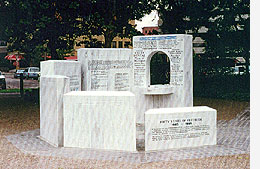 HMMM
HMMMI thought the meaning of the 33 foot sculpture (pictured below) recently erected at Grand Rapids - the home of the world's first mass fluoridation experiment - by the West Michigan Dental Association, was quite clear.
Regards
Dennis Stevenson
Firstly, at the right of the picture is a patient. That they are a dental patient is obvious from their mouth being wide open. As their tongue is all the way out, obviously they are screaming. We'll get to why they are screaming in a moment. Gathered around the patient are 5 dentists. Equally obviously, as there are five dentists and not just one, it must be a training session, as only one dentist is required to extract whatever money a patient might have.
The two dentists on the left can be seen to be senior to the other three, as is clearly shown by their height. The tallest dentist is the lead instructor and his colleague, on his immediate right, is the 'watchdog'. I'm sure all of us are aware that when a dentist speaks at a public meeting, there has to be another ADA approved dentist in the audience to report on what the first dentist says.?Naturally the same requirement exists when dentists are being trained. Though it is almost preposterous to consider that any ADA approved dentist would tell the truth (remember what happened to Mel Gibson in the movie Conspiracy Theory) the ADA is ever vigilant to ensure that no dentist should mention, even accidently, that fluoridation is anything but "absolutely safe and effective". Though it seems silly and is extremely unlikely to occur, imagine the repercussions if a dentist told students that fluorosis was chronic fluoride poisoning of the 'whole body' and not just a 'minor cosmetic effect' on teeth only?
Which leads us into exactly what the trainee-dentists were learning at the time the picture was taken. This is revealed by the attitude of the students. You will note their proximity to the patient: this shows that the 'cosmetic effect' of dental fluorosis is being discussed and specifically, the vast fees that can be made from gluing white plastic covers over the fluorosis disfigured teeth of patients - at $600 to $1,200 per tooth. This is, of course, why the patient is screaming.?
However, you can imagine why the trainees are so excited. Not only have they just learned how much they can charge patients, but they have also discovered that fluorosis, or 'egg-shell white' mottling as they prefer to call it, is a never-ending source of money, provided they keep promoting fluoridation, as this is what causes the mottling. Now they realise how they can easily pay cash for a new premier Mercedes every year, not to mention the endless golf and wonderful conferences sponsored and paid for by Mars Bars Pty. Ltd.
You will also notice at the bottom left side of the picture, almost hidden behind trees, is what can just be seen of a car window. The window, exactly positioned so that it has a clear view of the meeting through the trees, looks black. However, expanded digital film analysis reveals that state of the art video equipment is recording everything that is being done at the meeting. This is another requirement of Sigma-Delta-Sigma, the secret society of dentists, which dentists are on a blood oath never to mention. You may recall the deputy President of the NZ Dental Association who accidentally acknowledgedly that the society exists before he realized his error and stumbled out with "My membership of any organisation has got nothing to do with your interview." Have you ever seen him again?
Something to also be seen in the photograph is the golden path. Because of poor reflection, this shows in the photograph as a white section on which the dentists are standing. This is always there when dentists are being trained to ever remind them of the dental brotherhood and the riches that await them if they obey the 5 Golden Rules.
You will notice one of the dentists, the smallest and most junior one, has the 5 Golden Rules written on his back. Enlarged, they read:
1. I promise to always pretend I and brother dentists are doctors though we are not medically qualified and do not have doctorates.
2. I promise to protect any brother dentist who kills a patient with mercury or a topical fluoride treatment.
3. I promise to?charge every patient extras for: cleaning, topical fluoride treatment and x-rays and to never reduce fees or disclose to outsiders how many hundreds of thousands of dollars I make annually.
4. I promise never to publicly debate fluoridation but only to forever repeat the dental mantra "Fluoridation is absolutely safe and effective". I will always vehemently deny that fluoride is a rat poison.
5. I promise to follow the 50 year old published advice from the American Dental Association to always denigrate and ridicule those who speak against fluoridation, no matter how well qualified they are.
Hopefully this brought a smile to your lips...it did to ours but we are too easily amused.

